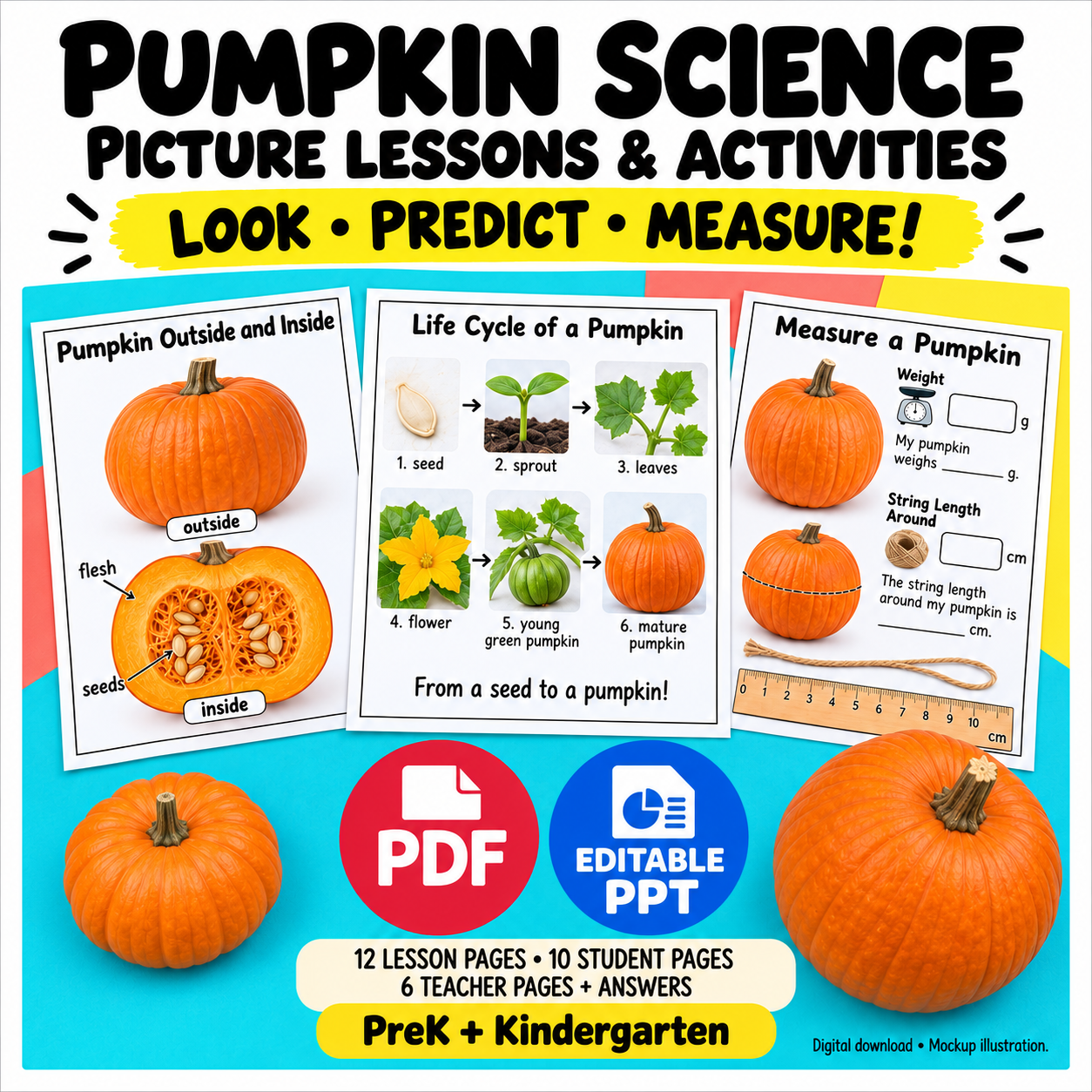
Pumpkin Measurement Station: Weight and Distance Around
A useful pumpkin measurement station asks two separate questions: How heavy is it? How far is it around? Use a scale for the first and nonstretch string with a ruler or tape for the second. Keep each reading beside its unit so children can explain what the number describes.
This adult-led routine is for Kindergarten, with pointing and dictation available for younger participants. Begin with one pumpkin. Add a second only when children understand the measurement method; a crowded table of pumpkins can hide the distinction you want to teach.
In this guide
Prepare a stable adult-managed station
Gather a scale with enough capacity, a ruler or measuring tape, nonstretch string, paper and crayons. Adults carry pumpkins from underneath, position them on the scale and manage the string. Illinois Extension’s handling guidance explains why the stem should not be used as a handle.
Label the pumpkin A. Check the scale is ready according to its instructions and use one unit throughout the comparison. Avoid introducing a scale children cannot read while also expecting them to master the number notation independently.
Record a prediction separately
Ask, “What do you think the scale will tell us?” A child can predict heavier or lighter than another known classroom object without guessing a precise numeral. Write Prediction in a separate space from Reading.
When a reading appears, keep the original prediction. A revised statement such as “I thought A was heavier; the readings show B is heavier” demonstrates comparison. Erasing the prediction makes that thinking harder to see.
Measure weight before measuring around
An adult places the pumpkin securely on the scale. Read the display together and write the actual number and unit. Use the language of the scale consistently; do not switch between grams and kilograms halfway through a comparison without explaining the conversion.
Next, identify a route around the fruit, such as its widest horizontal part. Wrap the string along that route, mark the meeting point and lay it straight beside the ruler. Children can point to the start and marked end while the adult reads the length.
Troubleshoot two different answers
If two groups report different lengths, compare the route and string tension. One string may have crossed the stem while another stayed around the middle. Repeating the same method is more informative than voting for the most popular answer.
| Record | What belongs here | Check before comparing |
|---|---|---|
| Weight | Scale reading plus unit | Same scale and unit |
| Distance around | String length plus unit | Same chosen route and method |
| Observation | One note about the process | Note any method change |
Do not compare an unlabelled 30 with an unlabelled 900. The units and measurement question give those numbers meaning. A longer string also does not prove which pumpkin weighs more.
Let children explain the tool choice
Offer two sentence frames: “We used the scale to find ___” and “We used string to find ___.” Let children demonstrate rather than requiring a written paragraph. An extension is to find a different object whose distance around can be measured with the same method.
End with one record checked against the original tool. For a later lesson, use the pumpkin journal routine to keep predictions and readings together.
Optional teaching and response pages
Pumpkin Science Picture Lessons and Activities is the paid companion resource for PreK and Kindergarten. It includes PDF and matching editable PPTX with picture lessons, student tasks and teacher guidance. Real pumpkins, a suitable scale, measuring tools, printing and adult preparation are separate. The station described here is a proposed way to use the topic; no particular measurement result or teaching time is guaranteed.