Pumpkin Science Activities for Preschool: Look, Predict and Measure
Start a preschool pumpkin science investigation with two questions: What can we see, and what do we need to measure? Children can compare the outside, look at an adult-prepared inside view and predict which of two pumpkins is heavier. An adult then weighs both on the same scale. Keep the prediction and the measured result separate.
This guide is for adults teaching PreK and Kindergarten. You can use the observation routine with your own pumpkins and paper. The optional picture lesson supplies coordinated teaching and recording materials; the real measurements still come from your classroom.
In this guide
- Prepare two pumpkins and a simple recording space
- Look at the outside before naming the parts
- Compare the inside with the outside
- Predict which pumpkin is heavier, then check
- Measure around the pumpkins
- Connect the fruit to a growing plant
- Choose a picture lesson when you need matching materials
- Questions teachers often ask
- Teacher references
Prepare two pumpkins and a simple recording space
Choose two manageable pumpkins with sound surfaces. Adults should carry them from underneath rather than by the stem. Gather a suitable scale, nonstretch string, a ruler or measuring tape, crayons and paper. Use the same scale and unit for both pumpkins. Keep the scale on a stable surface and within its capacity.
Prepare an inside view before children arrive if you want to compare inside and outside. An adult handles cutting and sharp stems. Children can observe without tasting or handling loose seeds. Adapt the activity for children who prefer looking to touching.
Plan a short observation session first and a separate measurement session if attention is fading. A useful stopping point is one drawing and one spoken explanation, rather than finishing every activity at once.
Look at the outside before naming the parts
Ask children to describe what they notice: a curved outline, ridges, a firm surface or a stem. Invite them to point to the feature supporting their words. Avoid making orange the definition of a pumpkin: varieties differ in color, shape and size.
Try these prompts:
- “Show me a place where the surface changes direction.”
- “Which detail could you add to your drawing?”
- “What looks the same on these two pumpkins?”
- “What is different?”
A child can point, draw or dictate. Accurate observation matters more than spelling a label independently.
Compare the inside with the outside
Show the prepared inside view or a clear picture. Help children distinguish the outer rind from the flesh and the seeds inside. Ask them to draw one detail they can see outside and one they can see inside.
Do not ask children to infer an exact seed count from a picture. A picture represents a particular view, and real pumpkins vary. If you are using illustrations, identify them as illustrations rather than evidence that every pumpkin has the same interior.
Predict which pumpkin is heavier, then check
Label the pumpkins A and B. Before weighing, invite a prediction: “I think ___ will be heavier because ___.” Write it down without marking it right or wrong.
An adult weighs A, records the reading with its unit and repeats for B. Read the two results together. “It looked bigger” is a reason for a prediction; the scale reading is the evidence for this comparison. If the result surprises the group, let children revise their statement.
| Pumpkin | Our prediction | Scale reading and unit | What we can say now |
|---|---|---|---|
| A | Record before weighing | Record the actual reading | Use the readings to compare |
| B | Record before weighing | Record the actual reading | Explain with evidence |
No result is supplied in advance. You are comparing these two pumpkins, not proving a rule that the larger-looking pumpkin always weighs more.
Measure around the pumpkins
Measure around a chosen part of each pumpkin with nonstretch string. Adults manage the string, mark the meeting point and measure that length with a ruler or tape. Use the same method and unit for both pumpkins.
Explain the distinction in everyday language: “This tells us how far around it is. The scale tells us how heavy it is.” A longer string does not replace weighing. If a child’s measurement differs, check the string position and tension before discussing the difference.
Connect the fruit to a growing plant
Use pictures to trace a seed, seedling, growing vine, flower, young fruit and mature fruit. Explain that pumpkins grow on vines. An illustration of stages is a model of growth; it does not show how many days your own plant will take.
If a real plant is available, record a date and one visible detail. Return later and compare dated observations. Without a plant, children can sequence pictures without claiming they have observed growth over time.
Choose a picture lesson when you need matching materials
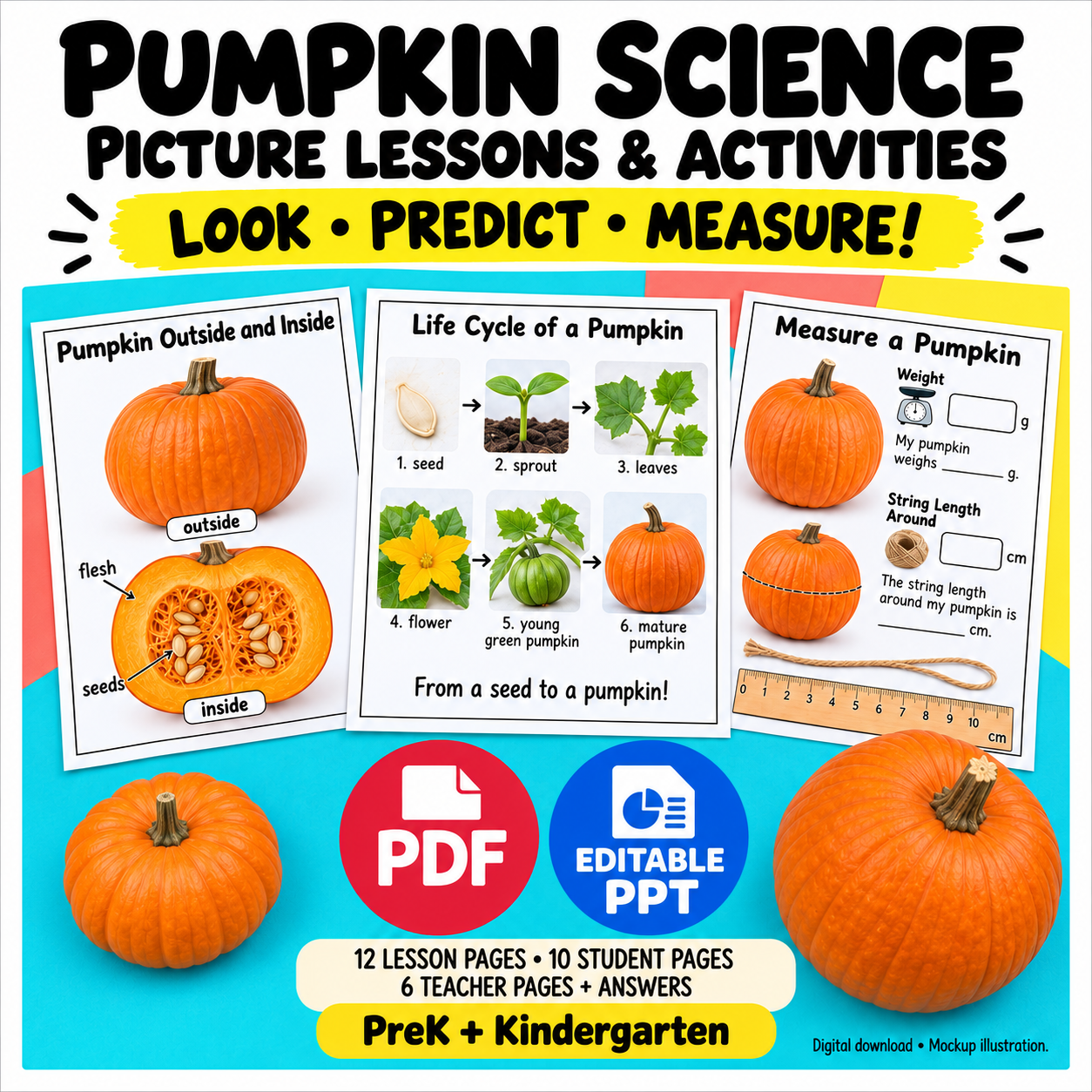
Pumpkin Science Picture Lessons and Activities on TPT contains 12 picture lesson pages, 10 student pages and 6 teacher guide/answer pages. The 28 unique pages are supplied in PDF and matching editable PPTX, with Start_Here.txt. The current download is English.
The resource supports parts, growth, prediction, weighing and measuring around pumpkins. It does not include real pumpkins, a scale, video or a live interactive website. Extract the ZIP completely, use a PDF reader for printing and compatible presentation software for editing. An adult prepares and supervises the real-material activities.
Questions teachers often ask
Can we do this without cutting a pumpkin?
Yes. Compare whole pumpkins and use a clear inside picture. Children can still distinguish what they observed directly from what the picture shows.
What if we have only one pumpkin?
Observe its parts and record its measurements. Save the two-pumpkin comparison for another day; do not invent a second result.
Does the bigger pumpkin always weigh more?
Appearance alone does not give the reading. Weigh your two pumpkins and describe the result for that pair.
Teacher references
Illinois Extension’s guide to choosing a pumpkin supports handling fruit from underneath and checking its condition. Its pumpkin varieties guide shows variation in fruit size, color and growth. The classroom routine above is an activity proposal, not a report of classroom testing.