Marigold Paper Craft: Support Cutting Without Taking Over
Support a layered marigold paper craft by separating the decisions children can make from the cutting an adult may need to help with. A child can choose colors, order the pieces and direct assembly even when an adult pre-cuts the shapes. Participation does not depend on completing every step independently.
This guide is for adults working with Kindergarten through Grade 2. It refers to the three-piece printed flower design, not a tissue-paper folding method. Check the actual template and test your paper before deciding how much cutting support to provide.
In this guide
Choose one main goal for the session
Decide whether the focus is cutting a curved outline, sequencing the sizes or explaining the construction. These goals can occur together, but a child who needs cutting help can still demonstrate ordering and explanation.
Show the finished arrangement as an example, not an identical result everyone must reproduce. The resource’s flower images are illustrations of the intended design. Assemble a physical sample with your chosen paper before class; an illustration does not establish how stiff your printout will be.
Prepare support before handing out scissors
Use child-safe scissors under adult supervision. Print on paper or light cardstock suited to your group and equipment. Adults may pre-cut all three pieces, start an outside edge or help rotate the paper while the child controls the scissors, according to the child’s needs and classroom practice.
Do not require a child to demonstrate difficulty repeatedly before offering an alternative. Set out pre-cut pieces as an ordinary way to participate. Children can also indicate choices by pointing or telling an adult where to place a piece.
Teach the outside outline explicitly
The printed petals include interior lines. Show which line is the outer boundary of the whole piece. Say, “We keep the center and cut around the outside.” Do not cut every inner line into a separate petal or remove the center where the pieces join.
Offer one shape at a time when three pages feel overwhelming. Put completed pieces on a tray so they remain available for ordering. Coloring can happen before cutting, but an adult can adapt that order when it helps the child handle the materials.
Keep the construction decisions with the child
Ask which piece belongs at the bottom and how they know. Place the largest piece, then the medium and smallest. Gently lift the outer petals if the paper allows, put a small amount of glue at the centers and press the centers together.
A flatter stacked flower is a valid adaptation. Do not add more glue over every petal merely to imitate a highly dimensional illustration. Let the flower dry before moving it into a display.
| Support | Child’s meaningful choice |
|---|---|
| Adult pre-cuts pieces | Choose colors and order sizes |
| Adult steadies paper | Follow the outside edge with support |
| Adult applies glue | Direct where the centers meet |
| Adult writes a response | Explain one visible layer |
Invite an explanation rather than a neatness score
Ask, “Which part did you decide?” or “Show me the middle layer.” Accept a gesture, spoken response or drawing. Record the choice rather than comparing children by speed or identical petal shapes.
Use the size-ordering flower activity when ordering is the next goal. For cultural context and display wording, use the marigold classroom display guide.
Optional matching templates
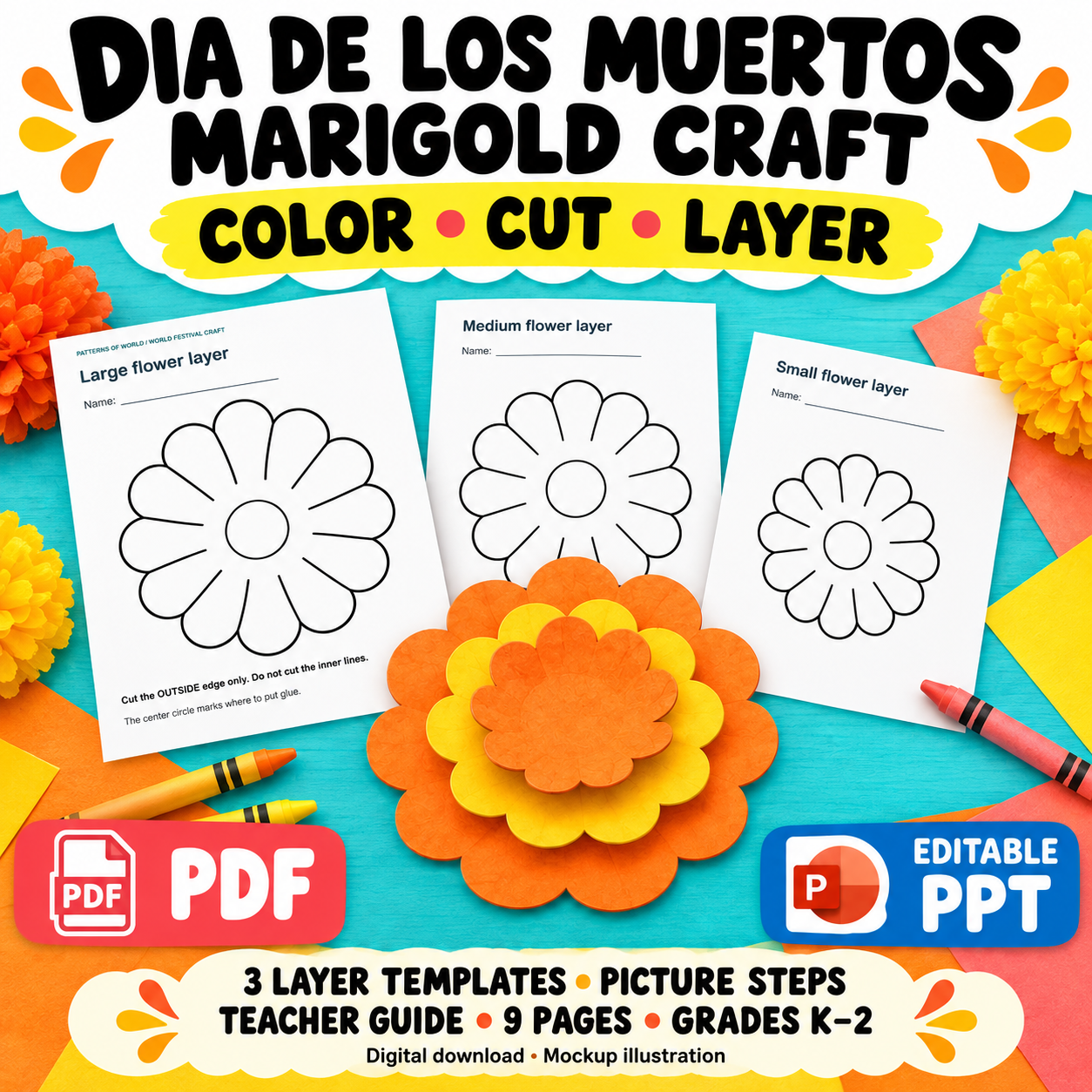
Dia de los Muertos Marigold Craft: Color, Cut and Layer is the related paid English resource. It contains 9 unique pages in PDF and matching PPTX, including three templates, picture steps, a drawing response and teacher guidance. Extract the ZIP and print at Actual Size / 100%, checking the supplied one-inch line. Physical supplies and a tested classroom sample are separate. No developmental or therapeutic outcome is promised by this suggested adaptation.