A Respectful Marigold Classroom Display for Día de los Muertos
A marigold classroom display should explain both what children made and why the flower appears in a Día de los Muertos lesson. Use a brief cultural introduction, display paper models with children’s construction comments and keep personal remembrance optional. A craft display is a small introduction to a living tradition.
This guide is for Kindergarten through Grade 2 educators. It uses the printed three-layer flower craft. It does not ask children to practice a belief, disclose a family loss or make a classroom altar as a required assignment.
In this guide
Begin with an attributed cultural introduction
Explain that many Mexican and Mexican American communities observe Día de los Muertos as a time of remembrance. Marigolds called cempasúchil are used in many offerings and commemorations. Families and communities vary in how they observe the occasion.
The Smithsonian’s introduction to Día de los Muertos describes marigolds among its symbols and remembrance practices. Read the source before teaching and name it when sharing that background. Avoid presenting the holiday as another name for Halloween or suggesting every family follows one identical practice.
Decide what the display is intended to show
A useful focus is “Paper marigolds: color, cut and layer.” Add a short explanation of the cultural connection nearby. Keep the paper-making process visible so visitors understand that the flowers are models, not real specimens.
If a wider school celebration or community-led display exists, coordinate wording and participation with the people organizing it. A classroom craft guide cannot represent every tradition or replace community knowledge.
Give children a clear participation choice
Children can discuss the flower’s shape and the way their paper pieces overlap. Sharing a personal memory is optional. Do not require names or photographs of deceased relatives, statements of belief or accounts of bereavement.
Offer a way to observe, draw a flower or explain the construction without personal storytelling. Keep any contribution within the school’s normal privacy and permission practices. A child’s choice not to share should not be made into a public display label.
Assemble and check before displaying
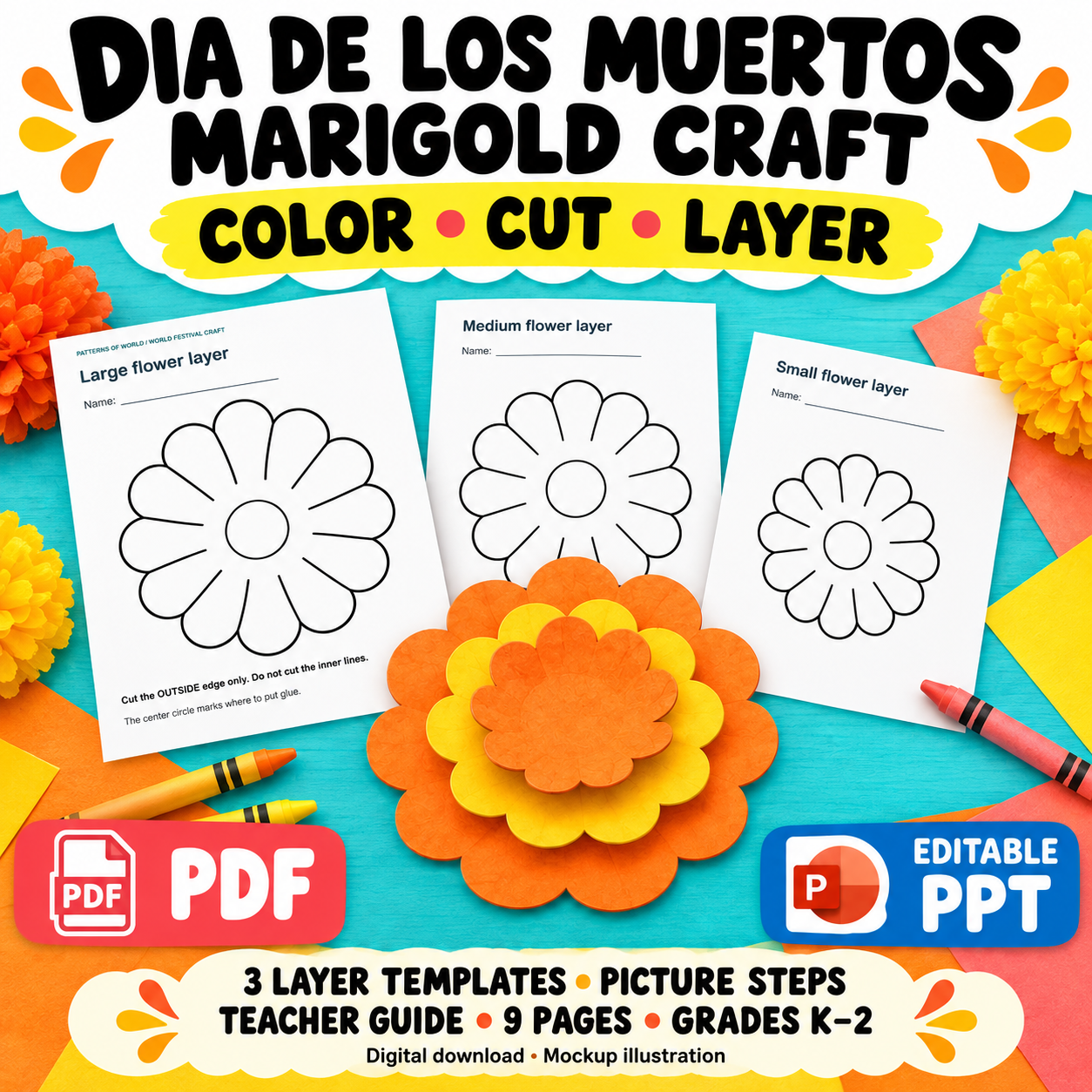
Print the templates at Actual Size / 100% and check the supplied one-inch line. Adults supervise cutting or provide pre-cut pieces. Order large, medium and small, gently lift outer petals if appropriate and join the centers with a small amount of glue.
Allow drying time and check each piece is attached before mounting. Use a stable display sheet or suitable classroom backing. Do not promise a free-standing sculpture or a particular curved shape before testing the paper. The resource’s finished examples are illustrations of the design.
Let the labels describe children’s decisions
A child can dictate one short caption:
- “I put the largest piece at the bottom.”
- “I left the outer petals free.”
- “I can see three layers from the side.”
Keep these process captions separate from the teacher’s cultural explanation. A child’s construction choice should not be presented as a statement about all Día de los Muertos practices.
Place labels beside the corresponding flower with readable spacing. Avoid crowding several unrelated seasonal crafts around a tiny paragraph of context. The display’s reading order should make the title, cultural connection and children’s work easy to find.
Make the follow-up a conversation
Ask visitors or classmates, “What can you tell about how this paper flower was made?” Invite children to point to a layer while answering. For practical support, use the cutting adaptations guide. For the complete assembly sequence and public preview, see the marigold craft guide.
Optional printable resource
Dia de los Muertos Marigold Craft: Color, Cut and Layer is the paid English companion. Its 9 unique pages include three black-and-white templates, two lesson pages, a drawing-and-telling page and three teacher/reference pages in PDF and matching PPTX. Extract the ZIP; physical supplies are separate. The display plan and caption suggestions in this article are editorial additions, not claims of classroom testing or a complete cultural curriculum.